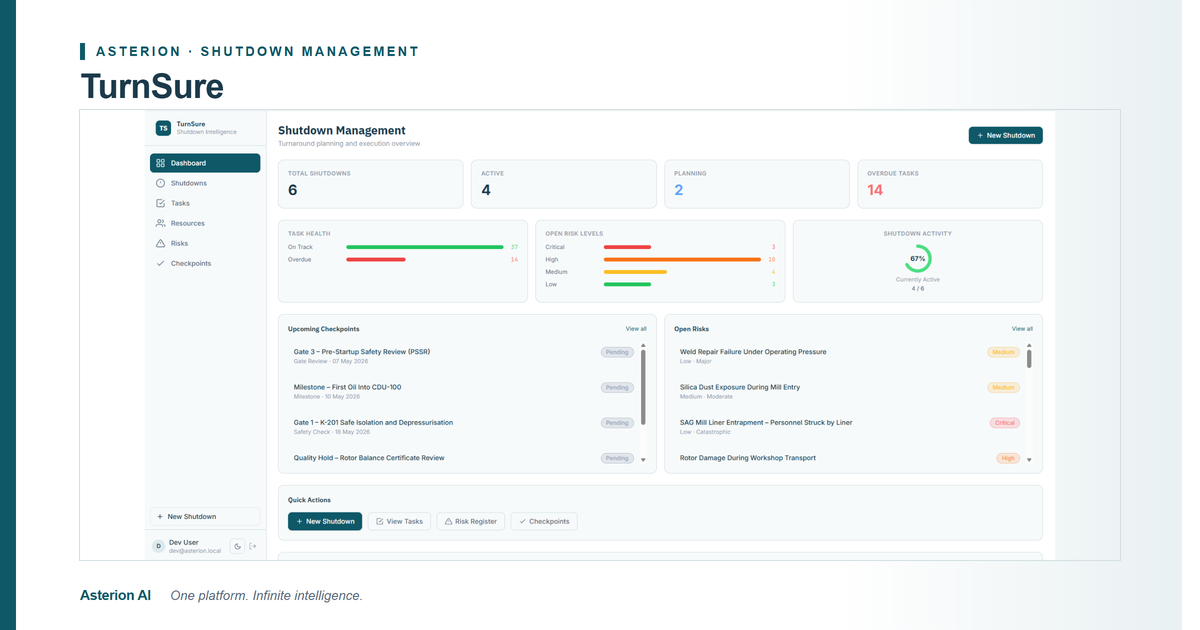
Governance from shutdown planning through execution, aimed at the overruns that eat a year's production.
Download the product overview (PDF)
One overrun can wipe out the value of a year's production. Most shutdowns are still planned in spreadsheets and handed over verbally.
Structured scope capture with work pack creation, approval workflow, and traceability from the original scope line to the task that was executed.
Configurable readiness scorecards at each phase, including a DCMA-14 schedule-quality assessment, with automated gating and risk flags. Daily briefs tell the shutdown team what changed overnight.
Labour, equipment and contractor requirements modelled against scope, with availability checks and conflict detection before the conflicts arrive.
Critical path analysis, constraint management and compression, driven by real asset and resource data rather than by assumed durations.
Live completion, variance and exception tracking against plan. Governance decisions are written to a hash-chained ledger, which is what makes post-event assurance possible.
Structured review with cost analysis, schedule variance and recommendations, while people still remember what happened.
Society for Maintenance & Reliability Professionals Body of Knowledge
Center for Chemical Process Safety Guidelines
Process Safety Performance Indicators
Project Management Body of Knowledge
Failure predictions and asset criticality drive scope priorities and work pack generation, so the shutdown addresses what is most likely to fail.
Asset hierarchy and documentation feed scope definition and work pack planning.
Resource requirements pull workforce availability and competency, which is usually where a plan first meets reality.
Own the shutdown end to end, from scope definition through to the post-event review.
Build and maintain the schedule, the resource plan and the readiness assessments.
Track execution and production impact while it's still possible to change something.
Hold safety and permit compliance through the execution window.
We look at how you plan shutdowns now: the governance you have, and what your last few turnarounds actually cost against what they were meant to. The root causes of overrun tend to repeat.
Plan it properly. Prove it happened.
Frequency, complexity and regulatory environment change what readiness means.
Governance gaps and the recurring causes behind your overruns.
What happens from day one, agreed before anyone starts.
 TURNSURE · SHUTDOWN & TURNAROUND ASSURANCE